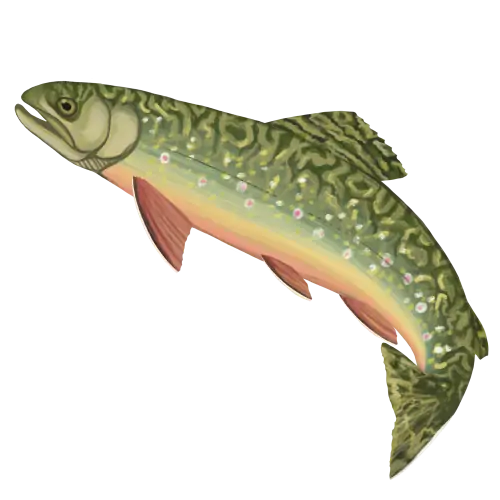
Brook Trout
Fish - Salvelinus fontinalis

The brook trout has a dark green to brown color, with a distinctive marbled pattern (called vermiculation) of lighter shades across the flanks and back and extending at least to the dorsal fin, and often to the tail. A distinctive sprinkling of red dots, surrounded by blue halos, occurs along the flanks. The belly and lower fins are reddish in color, the latter with white leading edges. Often, the belly, particularly of the males, becomes very red or orange when the fish are spawning. The brook trout inhabits large and small lakes, rivers, streams, creeks, and spring ponds. They prefer clear waters of high purity and a narrow pH range and are sensitive to poor oxygenation, pollution, and changes in pH caused by environmental effects such as acid rain. Brook trout have a diverse diet that includes larval, pupal, and adult forms of aquatic insects (typically caddisflies, stoneflies, mayflies, and aquatic dipterans), and adult forms of terrestrial insects (typically ants, beetles, grasshoppers, and crickets) that fall into the water, crustaceans, frogs and other amphibians, molluscs, smaller fish, invertebrates, and even small aquatic mammals such as voles and sometimes other young brook trout.
Description Source: https://www.inaturalist.org/taxa/49596-Salvelinus-fontinalis
Photo Source: Brook Trout by Marrabbio2, (n.d.). https://www.inaturalist.org/taxa/49596-Salvelinus-fontinalis. Licenced with Public Domain.